
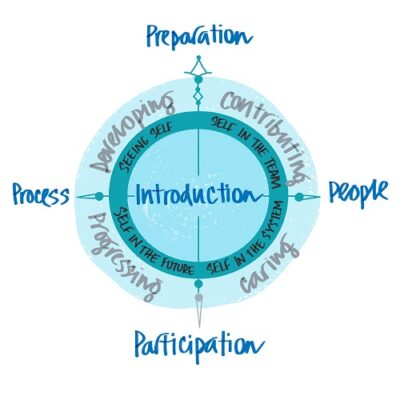
- Introducing Personal Leadership is developed to support your understanding of the underpinning purposes and processes of the programme.
- Introducing Personal Leadership will include self-study and reflection before arriving at the first workshop PERSONAL LEADERSHIP.
- Introducing Personal Leadership is an opportunity to settle yourself in the format to enable us to arrive prepared to convene as a learning group.
MODULAR CONSTRUCT
This toolbox is structured around 5 core modules. Depending on your programme you may not be required to complete the work for every module:
- PERSONAL LEADERSHIP
- STRENGTHS
- COMMUNICATION
- INFLUENCE
- CRYSTALLISING LEARNING
Each of these modules has its own ‘tab’ in this toolbox. There you will find all the pre-work, as well as downloads, videos, and other materials for future reference. We hope this makes it easy to follow and of course if you have any questions or concerns, please don’t hesitate to contact me by email: [email protected]
PRE-WORK THOUGHOUT THE PROGRAMME
At each stage of the programme there will be around 6 hours of self-study which will include working though the content in this toolbox and having a conversation with your Thinking Partner who will be a fellow delegate. This allows the workshops to function as Thinking Spaces and for me to facilitate reflections, rather than present information.
In addition you will be issued with a Learning Grid which is unique to your programme and has all the dates, the hyperlinks and the references to the pages in the Workbook.
PRE-WORK FOR WORKSHOP 1: PERSONAL LEADERSHIP
- Read through everything as you scroll down to the end of this section and this section.
- Please download your values report and your Transactional Analysis scores and bring them with you to the Workshop.
- Conversation with your Thinking Partner.
PRE-WORK FOR WORKSHOP 2: STRENGTHS
- Read through everything in this section.
- Read the textbook ‘How Full is Your Bucket’ and complete the Strengths Assessment. This can be found at the back of the book via a unique access code to Gallup’s website.
- Please download your strengths report and bring it with you to the Workshop.
- Have a conversation with your Thinking Partner.
PRE-WORK FOR WORKSHOP 3: COMMUNICATION
- Read through everything in this section.
- Read the summary of the Fierce Conversations book and complete an Opening Statement for a Conversation you have been avoiding and bring to the workshop.
- Have a conversation with your Thinking Partner.
PRE-WORK FOR WORKSHOP 4: INFLUENCE
- Read everything in this section.
- Create a Map of Influence and share this with your Line Manager or equivalent and get feedback prior to the workshop.
PRE-WORK FOR WORKSHOP 5: CRYSTALLISING LEARNING
- Read everything in this section.
- Create your Leadership Compass, share with your team and get feedback prior to the workshop. Send a jpeg image of your compass to Fiona, one week before your final day.
Facilitation Style
We will co-create with you an Adult-to-Adult learning and development environment, and this will provide a space where real practical learning can take place. This learning will include challenge and support, fun and creativity, individual and group activities, and a need to be fully present and engaged.
My belief is that the first job we have as leaders is to create an environment where people can think for themselves. That is our intention and one that I hope you will replicate with your own teams as the programme develops.
The learning spaces that are shared will be held using ‘Rules of Engagement’, created by Nancy Kline. Nancy created and pioneered ‘The Thinking Environment’. Her book, The Promise That Changes Everything, I Won’t Interrupt You, and the learning that I have done with Nancy has had a significant impact on my practice.
Nancy has a few simple rules of engagement that really help to facilitate great conversations and create respectful learning environments, and these are part of how we work together:
- The development is facilitated as a Thinking Environment – requiring respect, personal integrity and rigorous confidentiality
- A commitment to arrive on time and be prepared
- One voice at a time, no interrupting – when we interrupt, we interrupt thinking as well as speaking
- Listen with attention, grace and ease; suspending voices of judgement, cynicism and fear
- We are thinking equals; candidates challenge the thinking of the facilitator and each other, and vice versa – the fundamental premise being that we help each other to think better for ourselves, not that we want to be right
- We help each other to grow – we offer honest and detailed feedback about the impact of learning and behaviour
From a facilitation point of view, this way of working requires highly developed skills and behaviours; the philosophy is an antidote to the old world and an invitation into the new, where:
- Relationships are everything; we need deep, honest, and authentic relationships with all of the people we work with, to engage with the emerging future
- Conversation, challenge, creativity and collaboration are the edges of all of the relationships in this learning environment
- You are as much the expert as I am, we are thinking equals
- Risk is shared in the adventure to explore the future and it is ok to be vulnerable
- Collectively, we are the work, we are the impact and we are the role models
- Listening is paramount; to self, to others and to the sense of the future
Listen to Stephen Covey talking about Circle of Influence
Thinking Space
This Personal Leadership Programme is built on the foundations of Thinking Space being created:
- by Fiona MacNeill for you and your colleagues
- by you for your Thinking Partner on the programme
- and most importantly by you for yourself
Thinking Space for individuals will:
- Encourage directness, authenticity and personal accountability to hold up the mirror
- Assume that positive relationships are critical to success
- Give structure to the emotional dimension of thinking and the impact on personal effectiveness
- Explore assumptions and clarify decisions that the individual wants to make now
- Surface doubts and concerns, blind spots and unintended consequences
- Create the thinking that leads to real development and change for the individual
Thinking Space is typified by:
- The thinker thinking for themselves. It’s for anyone who wants to create the space to think and think differently
- The thinking partner acting as a custodian, taking care of the thinking through attention, appreciation and ease. Our only objective is to help you to think better for yourself
- The use of a specific framework for inquiry – including the Appreciative Inquiry 4D model and patterns of questions based on the work of Nancy Kline – designed from theory applied in practice
Resource: Thinking Space
Helpful additional information
Some fantastic clips of Nancy Kline speaking about what has inspired her work on Thinking Environments: https://www.timetothink.com/media/